“PASSO INDIETRO” A EAST BELFAST. NUOVI MURALES UVF

Due nuovi murales ritraente uomini armati dell’Ulster Volunteer Force ha fatto la sua comparsa in Newtownards Road
Un uomo d’affari che ha chiesto di rimanere nell’anonimato, pare non essere troppo interessaoa al significato intrinseco che potrebbe avere la comparsa di 2 nuovi murales raffiguranti uomini armati appartenenti alle fila del gruppo paramilitare lealista dell’UVF.
“Suppongo sia un omaggio al nostro passato. Ma ho sentito che ad un paio di persone non piace ma sono troppo intimoriti dal dire qualcosa. Per quanto mi riguarda possono lasciarlo o toglierlo”.
Ma all’interno della comunità di East Belfast non sono, appunto, tutti dello stesso parere. Nial O Donnghaile, assessore Sinn Fein, ha commentato: “La miglior risposta verrà dalla comunità. E’ davvero questo quello che vuole? Ne dubito”. Una comunità che non è stata coinvolta in alcuna consultazione in merito all’argomento.
Negli ultimi anni, si era scelto di coprire le opere murarie che sono il ricordo di un passato violento. Molti murales in tutta la città sono stati trasformati in immagini più accoglienti, sempre nel rispetto del patrimio e della cultura del Paese.
Solo alcuni sono stati conservati, e sono tutt’ora una delle maggiori attrazioni turistiche della città.
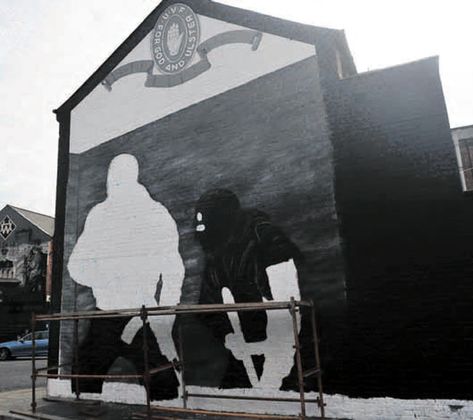
Loyalist murals return to east Belfast, and few welcome them (Belfast Telegraph)
The transformation of paramilitary murals that once loomed over many Northern Ireland housing estates has been a work in progress for some years now.
But in what has been described as a “backward step”, new murals of loyalist gunmen are currently being painted in east Belfast.
One businessman said the new paintings, depicting UVF paramilitaries holding machine-guns, are a tribute to the city’s past. But both loyalist and republican politicians said they are sending out the wrong message and must go.
The murals, currently being painted on the lower Newtownards Road, recall a sinister and violent past. Many murals across the city have been transformed into more welcoming images that still reflect heritage and culture.
While a number have been preserved — and have proven to be a big tourist attraction — the images in east Belfast are the first new paramilitary murals to appear.
PUP councillor for the area John Kyle said he does not think there is much community support for the new images.
“There hasn’t been any community consultation in regards to this. A few individuals appear to have taken it upon themselves. I’m not aware of much community support.”
Sinn Fein councillor Nial O Donnghaile said the images are intimidating for anyone travelling on the Newtownards Road, and called them “a backward step”.
He said: “The best response will come from the community. Is this really what they want? I doubt it,” he said.
But one businessman, who asked not to be identified, said he had no problem with the images.
He said: “They are a tribute to our past, I suppose. But I have heard a few locals saying they don’t like them. They’ll be too afraid to say anything. As for me, I could take them or leave them.”
Background
Paramilitary murals were painted to depict history, political views and to mark territory. In recent years many have been replaced under a Government scheme to redecorate walls with more welcoming images. Some have been preserved, having become tourist attractions. Currently two new murals of loyalist paramilitary gunmen are being painted in east Belfast.
Loyalism’s struggle to carve out an identity
By Brian Rowan
It is a picture on the wall that sends out a completely wrong message.
The drawings in east Belfast are a grim reminder of conflict, of guns and shootings and of the dark days.
This UVF is meant to be an organisation that has moved into a “non-military, civilianised role”.
But these drawings are about war, not peace, about the old, not the new.
These murals are not just a problem in east Belfast, and not just a problem for the UVF.
In the south of the city at the entrance to Sandy Row there is another masked eyesore.
The UDA ‘brigadier’ Jackie McDonald wants it replaced — and knows that if it is not then those who are considering investing in the area will look elsewhere.
Loyalism is still struggling to find its place in the peace process.
In some communities it believes it owns the streets, and the people have to stay silent.
What the UVF is doing is putting distance between itself and the people — people who want to live in peace.
 The Five Demands