LOYAL ORDERS, UN INDOTTO ECONOMICO DA 55 MILIONI DI STERLINE
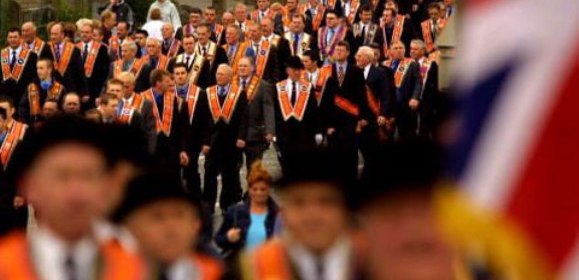
Loyal Orders contribute £55m to economy (UTV)
Loyal Orders and Protestant marching bands contribute almost £55m annually to the Northern Ireland economy, according to a new report.
For the first time research, funded by the Department for Social Development, has outlined the economic footprint and social capital contribution of the traditional Protestant parading sector to wider society.
It found the majority of the groups’ contribution, £39m each year, was attributed to the provision of facilities, community and volunteer work as well as fundraising for charities.
A further £15m is spent on regalia, uniforms, instruments, bus hire and other services.
David Montgomery, who manufactures band uniforms, said that uniforms, equipment and instruments all cost a lot of money.
“They all have to be manufactured, sold and the bands have to pay for them and remember that there’s over seven hundred bands in Northern Ireland – but you also have Scotland and England as well where there’s many, many different types of bands and a lot of them are buying stuff from Northern IreIand,” he explained.
The research did not account for tourism revenue created by those travelling to the region to observe or participate in parades.
Nor did it account for the cost of policing parades and related protests, a figure amounting to over £7m last year.
In October, Parades Commission chairman Peter Osborne warned the cost was unsustainable and must be reduced through dialogue.
Speaking on behalf of the eight Loyal Orders, Drew Nelson, Grand Secretary of the Grand Orange Lodge of Ireland, welcomed the report’s findings.
He said: “The Loyal Orders and bands are an integral part of the fabric and make-up of the Protestant community and it is appropriate that their social and economic contribution to wider society is now highlighted and measured by this extensive research.
“Whilst parading is an important part of our tradition and a visible expression of our culture and heritage, this study underlines the real economic and social impact of a vast sector which engages in substantial levels of activity away from the public gaze.”
The senior Orangeman said that the Loyal Orders provide 750 halls which are used by an estimated 6,000 groups on a regular basis.
He added:”Generous charitable donations to numerous worthy causes and countless hours of volunteer work also typify the selfless mindset of our membership.”
Nelson McCausland, Minister for Social Development, said the research highlights “the many benefits that the parading sector brings to Northern Ireland”.
Niall Ó Donnghaile, Sinn Féin councillor for Pottinger, said the findings do not reflect the experience of people, who leave the north over the summer due to the parades issue, and the impact that has on our economy.
“It doesn’t reflect the policing costs, quite substantial in terms of policing the few remaining contentious parades.
“So what I would say to the Loyal Orders is that there’s quite a taint in relation to this report and certainly there’s a willingness on the part of residents to remove that taint that’s there and try and improve the experience of these parades for everyone.
“But that will only happen by sitting down and engaging and direct dialogue in those areas where there are still contentious parades.”
Valerie Quinn, chairperson of the Confederation of Ulster Bands, described the estimated 660 marching bands as “custodians of a unique culture providing a platform for supreme musical talent”.
“While the economic impact of such a large community is clear for all to see, the wider benefits of band membership to our society cannot be underestimated, particularly in its guise as one of the largest social movements in Europe,” she commented.
“Like the Loyal Orders, marching bands are renowned for their charity work and community activities. They also provide an outlet for members – many of whom are young people – to learn and develop new skills and avail of expert training.”
Jenny Irwin, Managing Director of RSM McClure Watters, who carried out the research, said they were struck by the level of voluntary and charitable work carried out by members.
“Also the culture of helping others without seeking any PR or recognition for doing so,” she added
 The Five Demands