BELFAST PARADES, IL GIORNO DOPO: LE AMARE CONSIDERAZIONI DI McINTYRE
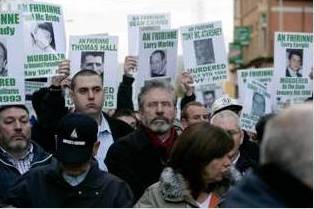
Gerry Adams Belfast Parade 2 november 2008
3 Novembre, il giorno seguente alle parate che hanno sfilato ieri nel centro città di Belfast. Giorno in cui molti repubblicani avevano riposto fiducia, la fiducia in un orgoglio repubblicana che purtroppo stando ai fatti è rimasto confinato in un angolo.
Molto eloquenti sono le parole di Anthony McIntyre, ex volontario dell’IRA, ex prigioniero che ha speso 18 anni della sua vita a Long Kesh. 4 anni di blanket e no wash/no work protest sfociata poi negli hunger strikes degli anni ’80. Abbandonato il movimento repubblicano a manifestazione di disapprovazione del Good Friday Agreement, è diventato giornalista ed uno dei fondati di The Blanket.
In un articolo apparso quest’oggi sul suo blog (The Pensive Quill n.d.r.) raccoglie i suoi sentimenti, le sue sensazioni e l’estrema amerazza suscitata dalle immagini di quanto è successo ieri a Belfast. Descrive quanto sia stato imbarazzante vedere sfilare il British Army regiment, il Royal Irish Regiment, per le vie del centro città.
“Il disegno che pretende di dimostrare l’uguaglianza e lo spazio condiviso, dai colori arancio e verde in pari quantità…un colore deve essere sbiadito…C’è stato poco verde e ma al contrario ricchezza di arancione a Belfast oggi (2 novembre 2008 n.d.r.)”
“Lo spazio che è stato condiviso, nel centro della città, equamente tra Unione Jacks e Red Hand of Ulste”
“Parlando ai media il leader dello Sinn Fein Gerry Adams ha detto che è stato riprovevole che ad un reggimento britannico sia stato consentito di sfilare per le vie di una città irlandese. Alcuni ritengono più riprovevole il fatto che lui e il suo movimento si siano ridotti ad una tale impotenza politica non essendo in grado di fare nulla”.
…questi sono solo alcuni degli spunti di riflessione di Antony McIntyre, forse un mera e triste presa di coscienza…

Anthony McIntyre
The resonance of cheering voices and stomping boots drowned out the sound of angry voices and marching feet. It was embarrassing to watch. The triumphalism of the British Army regiment, the Royal Irish, on public display in the heart of Belfast this morning punched yet another gaping hole in the approved narrative of the peace process. In that narrative a draw is projected as the outcome of decades of armed political conflict. The sketch of that draw purports to show equality and shared space, orange and green in equal amounts intermingled and daubed all over the place. One of the colours on the palette must have faded. There was little green and plenty of orange in Belfast today. The space that was shared, the city centre, was carved up equally between Union Jacks and Red Hand of Ulster flags. The equality on display was one of the RIR being on a par with political legitimacy. No chance of the Provisional IRA been allowed to march in uniformed formation past the City Hall. In the official pecking order it is the child of a lesser god.
Even if a yearning for the improbable is set aside and the IRA is taken out of the equation, look at the equality issue in another way. The Irish Army, if it sought to and was backed by Sinn Fein, would not be allowed to march through the country’s second largest city when it returns from peace keeping duties abroad. If there really was parity of esteem why would it not? It’s the unionists, stupid. They would never allow it and have been gifted the political clout to thwart it. They demonstrated today that Belfast is a British city where British troops not Irish soldiers, have the honour of marching through.
The RIR admired and respected within unionism, marched by the City Hall, enthusiastically cheered and warmly welcomed by a very large unionist gathering estimated at between 30,000 and 50,000 strong. The imagery on television was powerful. There is no doubting the strength of feeling in the unionist community for their troops. If numbers on the streets tell us anything the passion for the regiment is heartfelt in a way that opposition to it is not. Tens of thousands turned out to greet the British regiment while those either genuinely protesting out of conviction or going through the motions of protesting out of pressure or the need to politick have been numbered no higher that thirteen hundred.
Looking at the televised event it bore all the hallmarks of one of the participants to the Northern conflict, the RIR, flaunting the victory the British and unionists secured over their nationalist adversaries. The IRA, for its part, was forced to stand on the margins of the city centre, holding placards. It would have been much better for the counter assembly not to have proceeded. In that way the impotence of its Catholic organisers would not have been so pronounced.
I cannot recall the last time I witnessed such a public display of unionist confidence. Usually they gather in large numbers proclaiming themselves the underdogs and protesting some perceived advantage to nationalism. Today they gathered in celebration. It came on the back of a very upbeat DUP conference where Peter Robinson, brimming with confidence, promised no Irish Language Act, Ian Paisley junior swore that Gerry Kelly would never be policing and justice minister, and Willie McCrea stood up to sing ‘There will always be an Ulster.’ These people know the union with Britain is absolutely secure. A united Ireland does not figure in the slightest on their horizon.
Speaking to the media Sinn Fein boss Gerry Adams said it was reprehensible that a British regiment should be allowed to parade through the streets of an Irish city. Some will consider it more reprehensible that he and his movement are reduced to such political impotence they were unable to do anything about it. They fashioned the outcome that made partition legitimate. They gave support to the partition principle aka consent. They declared IRA arms illegal, the IRA redundant and crafted a political settlement that hegemonises unionism and legitimises the RIR. What else could they expect other than a victorious unionism saluting its troops?
If ever there was a political statement that graphically, accurately and concisely summed up the outcome of the conflict it was today’s British Army parade. A British Army homecoming parade to Ireland? Defeated imperial armies don’t march victoriously through the territory of their opponents. Triumphant national liberation armies don’t sit still and allow it.
 The Five Demands