IAN PAISLEY: MORTE DI UN UOMO D’ODIO
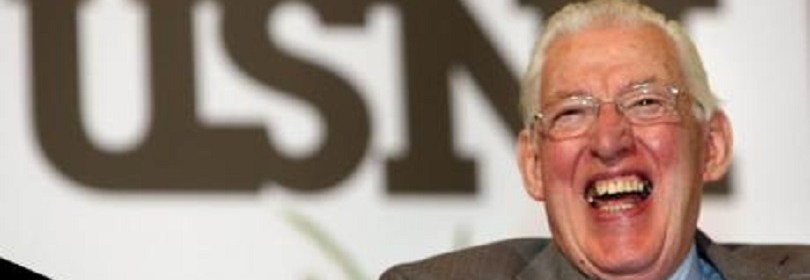
Death of a Hatesman (The Pensive Quill)
Is our politics still so fragile that we’ve to tell ridiculous lies about an obvious monster? Newton Emerson on Twitter.
When occurrences like the death of Ian Paisley take place an outsider might conclude that they are stage managed events, put in place to herald a ‘best bollix’ competition. And in this one, if it has not been served up already, then stand by between now and the day of the funeral for guff to be churned out in copious quantities: extra-large falsehoods to mask the extra-large failings of an extra-large ego.
Already the texts are flying as we are assailed by revellers urging us to party; pretty much like when Margaret Thatcher died. I don’t care if they arrive in my phone. I don’t care if they don’t. I took no joy from his dying. Nor did it make me sad. As was said about dying in the great novel on Rwanda, A Sunday by the Pool in Kigali, it is just something that we do someday. And almost everybody that died during the North’s politically violent conflict was much less culpable than Ian Paisley.
The founder of the Free Presbyterian Church was no innocent. He lived to a great age, 88, and died in his bed. The overwhelming majority of those who died in the conflict from all walks of life, combatants and civilians, never reached that age. Many of them died very young, not even out of their teens, in some cases not yet into their teens. We might not hear much of it today but they ended their lives gasping for air amidst the toxic fumes of venom unremittingly pumped out with satanic energy from a web of hatred, at the centre of which, like a banana spider, poised for both prey and power, lurked Ian Paisley. This man of god preyed with considerably more vigour than he ever prayed.
Martin McGuinness told us of the great “friend” (how the ‘r’ somehow got into the word, the peace process alone can explain) he had lost. Martin used to have other great friends who, unlike the one he lost this morning, did his bidding and killed members of Paisley’s congregation who happened to be members of the British security services defending the consent principle Martin now supports. Sometimes they were not even members of anything other than Paisley’s Martyrs Memorial Church. Their killers are not Martin’s friends any more, just traitors to the island of Ireland. Which presumably made Big Ian a friend to Ireland. With friends like that …
Paisley could no doubt tolerate McGuinness, whom he jokingly referred to as ‘the deputy’, pointedly reminding the former IRA chief of staff of his second class status in the “new” but not newly partitioned North. In the Derry Catholic, the Ballymena Protestant found validation and the path to his own political redemption, the midwife of the ogre-friendly language showered upon us this day. It was only after Sinn Fein had agreed to a new form of British policing for the North, did Paisley sup with the man he previously called a ‘bloodthirsty monster’. The ‘single greatest threat to the British state’ who had sworn to castrate the RUC, in the end came to suck its truncheon. Paisley, indeed had much to wax orgasmic about.
When they take to describing him as a statesman, my one thought will be of Henry Kissinger being lauded as a peacemaker. But we are used to this type of dross. We just don’t have to abide by it, or remain silent in the face of it either out of apprehension about causing offence to contrived sensitivity or of being labelled unhelpful to the peace process. Spin it, spoof it, anything but truth it, no weasel words can dilute it: Ian Paisley was one of the great hatesmen of Western Europe. Bertie Ahern might well try to clog clarity in telling us that Paisley was a ‘big man with a big heart’ rather than state the obvious that he was a big man with a big hate, who loathed with a biblical fury. To no avail: ‘I hate with a perfect hatred’ was heaven sent for the big man.
The death of Ian Paisley should not mean the death of our ethical language. For certain, it has been corrupted, not by having us speak English or Ulster Scots, but by inducing in us a desire to express ourselves in the vernacular of the peace process, Weaselanto, so that we might not find right words to describe wrong things.
In this home there will be no gloating over the death of Ian Paisley. Neither will he be mourned or missed. It would be less than human to say there is not a tinge of sorrow, not that he died, but that he lived.
Ian Paisley born in partition 1926; died in partition 2014, ‘after a long hard battle with hatred.’ Survived by more people living under partition than ever before.
 The Five Demands